Saturday, June 21, 2008

Moscow-City

Moscow, Russia - Out with drab, old-fashioned sameness and in with slick shiny newness. That's what Moscow is all about.

The city of Moscow is pouring billions of dollars into the development of a new business district which will be known as Moscow-City. In Russian, it's called "Moskva-Siti", the transliteration of the English word city, which must somehow be symbolic of its modernity and globalism.

At the moment, the place is a gigantic construction site. You might say this neighborhood is up-and-coming, with an emphsis on `up'. Skyscrapers of glass and steel tower 20 stories over the rest of the city, shining like beacons to Moscow's wheelers, dealers and fortune seekers.

There are two brand new metro stations - sleek and modern - without any of the brandishments that the older Moscow metro stations are famous for. And a covered pedestrian bridge connects two shiny buildings on opposite sides of the Moscow River. The walkway is lined with shops and cafes, all with huge glass windows overlooking the water. As far as I know, these tall towers are not for residential space, but rather, banks, businesses and all the other offices associated with capitalism.
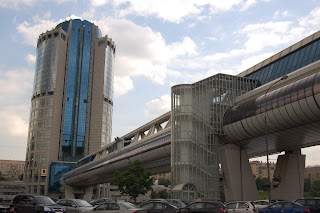
Moscovites are excited about this development, as well they should be. This cutting-edge architecture is bringing their capital into the 21st century. Moscow-City is forward-looking and money-making. It has the potential to revamp the world's image of their city.

Meanwhile, if you know where to look, you can find the remains of last century's cutting-edge architecture, less than a mile from here. In the 1920s and 1930s, Constructivist architects were inspired by the revolution to incorporate socialist ideals into their designs. They used sharp angles and geometric forms and lots of glass and steel. While this may sound like the contemporary skyscrapers we see in Moscow-City, its goals were very different.

Many architects concentrated their efforts on communal housing, which was envisioned to be the social unit of the future. The idea was to minimize individual space, encouraging residents to cook and eat together in communal dining areas, to share household chores and childrearing responsibilities, to free women from the daily grind of housework, and - according to architect Moise Ginzburg - to "[create] a new way of life."

The constructivists fell out of favor in the 1930s. When it came to family life, Stalin was conservative, preferring traditional gender roles and family relationships. Many constructivist buildings were forgotten, falling into disrepair over the course of the following decades. Only a few examples of this once cutting-edge architecture remain in the capital, the best being Narkomfin.

Built in the 1920s, Narkomfin was an apartment building for members of the Ministry of Finance. Apparently the block served as inspiration for Le Corbusier, as well as serving as a prototype for apartment blocks around the city. The style may not appeal to everybody, but its place in architectural history is undeniable.

These days, the place is in rough shape. It is still inhabited, but it is suffering from extensive water damage. More importantly, it occupies a prime place of real estate next to the American Embassy and a fancy new shopping center. Unfortunately, the ideals that inspired that constructivists don't do much for contemporary businessmen and bureaucrats... you gotta wonder how much longer Narkomfin will last.

Tuesday, June 17, 2008

Where is Mara now?

Moscow, Russia - The title of my travel blog used to be "Where is Mara now?" The idea was that the blog would answer the question that is burning inside all my faithful readers. (I have recently changed it to the more straightforward "Travel Blog" just in case it's not burning so much.)

Anyway this past week I was hard pressed to answer that question myself! Up until yesterday, I was home in the pink house. But I was being torn in all directions - answering editorial queries about my manuscript on Belize, showing photos and telling stories about my hiatus in Italy, and trying to prepare myself for my upcoming month in Russia. All that without leaving my house (in America). Four countries on four different continents left my head spinning.

Nonetheless, I managed to get on an airplane yesterday and this morning I woke up in Russia.  Belize and Italy are far behind me - as is America for that matter.

Not quite, though. In Moscow, I am sharing an apartment with an Italian woman and I already had to field one phone call from her monolingual mamma. The sun is shining and temperatures are up - not quite Belizean weather, but certainly warmer than when I left Boston. And the days are so long! I'm writing at 11:30pm and the sky is only now losing its last shades of light.

Just to ease my transition into Russian life, I had dinner at that all-American institution, the Starlite Diner. For those of you who have not been to Moscow, the Starlite is a long-standing icon for expats in Moscow, easing the transition for many people like me over the last decade-plus.

On my way there, I noticed that Bobby McFerrin (of Don't Worry, Be Happy fame) will be here next week. Did anyone else think that he committed suicide? I guess that was a nasty rumor - an urban myth - the work of somebody who was trying to be ironic, no doubt. Get to the bottom of it here.

In any case, you better believe that I'll be at the Tchaikovsky Concert Hall next week, grooving with Bobby, not worrying and being happy.

Wednesday, June 11, 2008

Let's go to the video clip

Somerville, Massachusetts - A few people have asked whatever became of my attempt at TV stardom, so here is an update...

In case you missed the background on this story, a few months back, I was invited to audition for the role of travel host for the new Lonely Planet TV show. I was in Italy at the time, and I frantically put together a video clip about Carnival. In retrospect, I realize it was not the most original idea for a show that is supposed to be about getting off the beaten track. But I was short on time and I was new to the country, so I was working with pretty limited resources. And the video did not come out half-bad, if I do say so myself. If you have not yet seen that creative masterpiece, you can do so here. (And check out my new page on Italy while you are at it!)

It did not take long for Lonely Planet to decide that I am not the travel host they are looking for. The "new faces of Lonely Planet" are two of my colleagues, and you can see their video clips here:

John Vlahides

Dominic Bonuccelli

It's pretty clear from these successful clips that my perky presentation style was not exactly what LP had in mind for their new show. Indeed, the folks at LP TV announced that "we still haven't found the right girls to join John and Dom on the road." So it's not that I was beat out by some exceedingly talented and attractive women; they just didn't like me. Boo.

Anyway, it was my very first foray into the TV world, and I have to admit that I got a little charge out of standing in front of the camera. And somebody must have liked my clip, because I did get a follow-up nibble. LP has hired me to make a short video about my favorite places in Moscow while I am there next month. If all goes well, my own version of the Battleship Potemkin will be posted on the Lonely Planet website. Stay tuned.

Tuesday, June 3, 2008

Moscow's Image Problem: Who is to Blame?

Somerville, Massachusetts - Every time I return to Russia I am forced to recall my rocky history with the Motherland. Every time I apply for a visa, I wonder how much research that visa officer is going to do before he decides whether or not I am worthy to return. Every time, I sit on pins and needles, hoping that nobody is keeping track of my past battles with the tax police and other Russian bureaucracies.

This time around, I was careful not to state explicitly my mission in Moscow. I certainly did not mention my affiliation with Lonely Planet. That's the last thing I need... to remind the powers-that-be about my previous efforts to promote their fair city. I am hoping to sneak in under their radar, so they have no idea that the Moscow City Guide is being updated.

That's because my last update went over like a bag of bricks with the city officials. I can't explain why... nobody loves Moscow more than I do. Nobody is more enthusiastic about the history, the art, the nightlife, the dining... my god! I even love the dining in Moscow! That is nothing short of an irrational attachment.

Nonetheless, the city officials did not pick up on this enthusiasm when they perused the Moscow City Guide.

Apparently, in the summer of 2006, Moscow appeared at the top of two Top-Ten lists: Most Expensive Cities and Rudest Cities (neither of which had anything to do with Lonely Planet, these were random polls conducted by various research firms that were probably later banned from the city streets). In response, the city administration launched a public relations campaign, which - for some reason - entailed an all-out attack on my well-researched, purely-positive guidebook.

First, a report appeared on Russian Center TV (the Moscow-government-run TV station). "The guidebook was published by the popular publishing house Lonely Planet. Those who develop tourism in the Russian capital were shocked by recommendations given by the authors. They had never read such things about Moscow before." The report goes on to complain about warnings against crime, prostitution, fake vodka, AIDS and mites in Moscow.

Mites? Excuse me? I'm not sure what book they were reading. Okay, the Moscow City Guide does make a passing mention of the very real dangers of drinking fake vodka and engaging in unprotected sex. But it hardly dwells on these issues; we assume our readers are responsible adults.

That said, my book does not gloss over the potential dangers and annoyances of traveling to Moscow. Travelers need to be aware that crime is on the rise in Moscow so they can take the proper precautions. This is not a question of "image"; it is a question of fact. Just ask the Moscow Prosecutor, who had held a press conference on this topic earlier that same week.

This was my favorite comment by an Intourist official: "How could they write that prostitutes were standing on every corner in Moscow? ... This guide suggests that one can meet a loose woman in Moscow, but this is not true!" First of all, the guide does not make a big deal about prostitution in Moscow. It certainly does not say that prostitutes are standing on every corner. But c'mon - I'm not saying anything about the moral turpitude of the moskovski devushki - but if that tourism official is not aware that prostitution is a thriving industry in Moscow, perhaps he ought to get out more.

Despite its inaccuracies, this story spread like wildfire in the Russian press. The Russians love to blame foreigners for their troubles. My contacts sent my stories that were in all the major newspapers: Izvestiya, Moscow News, even the People's Daily (in China!).

Still, we might have ignored the exaggerated assertions. Until the story was picked up by The Guardian, which is one of the major daily newspaper in the UK. You can read the Guardian's article here.

Anyway, Lonely Planet responded, saying that "Lonely Planet is overwhelmingly positive about travel to Moscow. Traveler numbers to Moscow are increasing, and deservedly so. Our aim in publishing a guide to Moscow is to encourage more travelers to go there and to experience all that Moscow has to offer.”

I was also invited to respond, and I was quoted in a few articles. This is from Russian Newsweek (my translation!): "The guidebook was written by American Mara Vorhees, a professional traveler who, of course, now is indignant about the claims of the Moscow television station, but nonetheless demonstrates a love of the city. This `enemy of Moscow' seems to be quite an enthusiastic person, like those foreigners who live for a long time in the Russian capital without needing to."

That's me, one of those foreigners who live for a long time in Russia even though I don't have to!

Anyway, we didn't hear much about it after that, except one nice letter from a Lonely Planet reader:

"As a resident of Moscow for the past nearly 2 years, I just wanted to send you an e-mail of support in the face of the absurd comments made by the bureaucrats in Moscow. It is quite obvious that they have never read the book. It is also quite obvious that these people have no sense of humor. We found the previous Moscow book really useful...

If the Russian authorities were really keen to do something about their fairly negative perception among tourists, then they would be wise to shake up their immigration staff, tell their police to stop harassing tourists..., put the signs and station names in the metro also in latin script ... and generally make people feel a bit more welcome." Amen, Fran!

As far as I know, that was the end of the war between Lonely Planet and the Moscow city administration. And I have no idea what happened to the city's ill-fated PR campaign.

But I just got my visa in the mail. So I can breathe a sigh of relief (I can do my job!) And whether the city officials like it or not, I will be back this summer, telling more truths and spouting more superlatives about mad Moscow!

Tuesday, May 27, 2008

Traveling to Moscow FAQs

Somerville, Mass - I have turned my attention to Moscow, where I am headed next month. Part of my preparations involve trying to convince my oldest and dearest friend, Rebecca, to come visit me while I am there.

I am not sure at all if this is a good idea. Rebecca has the worst travel karma of anybody I know. This is the girl who had to be rescued from a practically sinking sailboat when she went sailing around the Keys. And this is the same person who - while flying from Chicago to LA - bumped her head on the overhead luggage compartment door and ended up with a concussion!

Rebecca assures me that she has had many trouble-free travel adventures. In her defense, I don't remember anything going terribly wrong when I used to tag along on her family vacations to Bar Harbor, Maine, when we were 13. And here we are at Paradise Cove in Malibu - no problems there!

Anyway, last week Rebecca sent me a list of questions about her potential trip. I thought these Frequently Asked Questions might be useful for anyone thinking about traveling to Moscow:

  • If I do it - what would be the best time period to look at if I pick a week or 10 days... ??

Now, I think that Rebecca was asking specifically about jiving with my schedule. But for the sake of these FAQs, let me answer this question more generally. The best time of year to go to Moscow is late spring (May or June) or early fall (September or early October). Summer is not bad either, although summer in the city is hot and the theaters are closed. If you don't mind cold weather and dark days, Moscow is beautiful in January and February, when everything is covered in a layer of white snow. Avoid March and April, when the snow turns to slush and the city becomes a massive mudslide.

  • What kind of arrangements would I need to make, or would I just stay in whatever room/apt you are in?

Again, I invited Rebecca to stay with me in my apartment, but this does not necessarily apply to the rest of my readership (though it doesn't hurt to ask!). So yes, you are advised to make some kind of advance arrangements for accommodations, especially during the busy summer months. One useful resource is Hotels & Hostels, a part of the Lonely Planet website which posts hotel reviews (written by yours truly!).

Unfortunately, hotels are outrageously expensive in Moscow. There is a dearth of hotels that are decent but not decadent, functional but not fancy. This - more than anything else - is what makes Moscow the most expensive city in the world.

  • Is there a better airport I should fly into and a recommended airline?

No recommended airline - just take whatever is cheapest! These days, international flights go in and out of two airports: Sheremetyevo and Domodedovo. Sheremetyevo always had an international terminal. Although it is a pretty bleak place, it was always the nicest airport because it did service the foreigners. Then one day, somebody decided to privatize Domodedovo airport. Suddenly Domodedovo is servicing the likes of British Airways and American Airlines (as of June 2) and the place has undergone a massive rennovation. And suddenly Sheremetyevo seems to be even more of a ghetto.

Personally, I don't care too much about the aesthetics of an airport because I don't intend (key word intend) to spend too much time there. In my opinion, the most important question is: how do you get there? Domodedovo is farther away, but it has a speedy, direct train service that will wisk you there in 40 minutes (not counting travel time to the station, of course).

Sheremetyevo tried to institute a similar service. Unfortunately the train does not quite make it all the way there, so you still have to take a shuttle bus that final leg to Sheremetyevo, for a total travel time of one hour and fifteen minutes. Plus travel time to the station. Which turns into a very long trip indeed.

All this is a very long way of saying that there is no preferred airport; both are equally inconvenient. In either case, I usually end up taking a taxi! And frankly, taking a taxi is not so bad, as long as you make a reservation in advance. If you try to pick up a cab at the airport you'll probably consume your travel budget for a week!

  • How much Russian should I try to cram in, or does everyone speak English?

No, everyone does not speak English. People speak English in the modern hotels and the most popular museums, but your average Sasha or Sergei on the street does not. I always recommend that visitors should try to learn the Cyrillic alphabet before they come. (It's not that hard - 36 letters, most of which overlap with our Latin letters!). Then at least you can identify your metro stop or street name when you see it on the sign.

It also helps to learn a few key words and phrases, mainly because it makes people happy if you make a little bit of an effort. At the very least, learn to say "Good Day" (Dobry den). Say it - and smile sweetly - before asking questions of locals; they might respond in kind.

  • How do they feel about American girls, traveling alone?

Are you kidding? They love American girls traveling alone! Seriously though, Russia is a very safe place for women to travel. Back in the day, when foreigners in Russia were few and far between, I used to have to deal with unwanted attention. Sometimes it was a random stranger on the street, who would approach me and ask Mozhno poznokomitsa? ("May we be acquainted?") I learned that a polite but firm "Nyet" would usually finish that conversation pretty quickly. There was the occasional (usually drunk) guy that was more persistent, but that was a rarity. Anyway, it seems that now foreigners are less of a novelty and therefore less intriguing than they used to be. At least I attract a lot less attention than I used to. (Anyone who suggests that it has something to do with being 10-15 years older gets banned from this blog.)

  • Would I need to bring anything special/important in terms of adapters, papers outside of passport, etc... any medical prep to bring?

Yes to adapters (just like Europe). No to medical prep (no special shots or anything like that). As for papers, everybody needs a visa! This is a three-step process that adds a couple hundred bucks onto everyone's travel bill:

  1. First, you have to get a letter of invitation, which is issued by a Russian travel agency or other tourist organization. In Moscow, I like Visa House (http://www.visahouse.ru/). The price varies depending what kind of visa you get, but the minimum is about $75 for an invitation for a single-entry 30-day visa. In my case, I need a visa for more than 30 days, so I ended up paying $110 for an invitation for a single-entry, three-month "business" visa.
  2. 2. Send your passport, invitation and visa application to your nearest Russian consulate, which in my case is in New York (http://www.ruscon.org/). Don't forget to include a money order for $131 (or more if you need a fast turn-around time). Include a prepaid FedEx airway bill and they will send it to you in 6-10 business days.
  3. Once you arrive in Russia, you must get your visa registered within three days of arrival. If you are lucky, your hotel will do this for you for free. If you are like me, you are not staying in a hotel, in which case the original inviting agency should be able to do it (sometimes for a fee). One of the reasons I like Visa House is that they do not charge to register your visa once you arrive in Moscow. Technically, you are supposed to get registered in every city where you stay three days or more. But the rules are so murky and there is really no way to enforce this. My advice is to register when you first arrive - wherever you arrive - and to register in your city of departure.

Any more questions? Feel free to post them below and I will try to answer. Otherwise, I look forward to seeing you in Moscow!

Friday, May 23, 2008

Top Nine Things to Come Home To

Besides the obvious things like family and friends, of course.

#9 - Sushi. Apparently there is a sushi restaurant in Venice, but somehow it seemed sacreligious to eat Japanese food in Italy. Normally, I come home from a trip and I am craving pizza, but not this time. I got my fix at Seiyo in the super-trendy South End. In typical South End fashion, it can't just be a sushi place, but must also be a high-end wine boutique. Those things don't even go together! But I'm not complaining - we bypassed the wine and went straight for sushi and saki, which hit the spot.

#8 - Service with a smile. I can't deny it. As an American, I appreciate it when a waiter or checkout person smiles and pretends that they like me. I figure it's the least they can do as they are taking my money. Of course it does not happen all the time, but it is something we expect from our service sector in the United States. Not so in other countries. Certainly not in Venice, where service is usually polite, sometimes efficient but rarely friendly. Sounds like another place that I sometimes travel.

#7 - High-speed Internet. We did have wireless access in our apartment in Venice. But the receiver was two floors up, in the landlady's flat, which meant a sketchy connection for us. Not to mention that it only worked in the kitchen. Not to mention that it was sometimes shut off at random, for indeterminate periods of time. We comforted ourselves with the reminder that we were living in a 15th-century townhouse and, really, what did we expect? The internet probaby didn't work very well back then. Anyway, nice to be back in the pink house, where the internet conncection is strong in every room, as well as the backyard, where I happen to be working now.

#6 - Lilacs. What luck, I arrived home just in time to witness the lilacs bursting out in all their blossom-filled, aromatic glory. The downside, I learned, is that if the lilacs are blooming it means it's too late to put down pre-emergent crabgrass control. So... looks like we will have a crabby lawn again this year. Apparently I did not inherit the grassy green gene from my father. But I did inherit his appreciation for a sweet-smelling flower, which I am enjoying right now in the shade of the lilac tree.

#5 - Gardening. Speaking of my backyard, I spent my first week pulling up weeds, planting herbs and annuals, transplanting perennials. I came home just in time to catch the tale end of the tulips, and my azaleas were also ablaze. Now my bearded irises are emerging, as is the rhododendron. It never ceases to amaze me how much joy and satisfaction I get from my little private plot. The appearance of new buds makes my heart sing. Eating homegrown tomatoes makes my mouth water. And as an antidote to sitting in front of the computer, there is nothing better than going out in the sun and digging in the dirt.

#4 - Massage. After all that digging and weeding, my muscles were screaming. Lucky for me, my friend and massage therapist, Katrina, has moved back up to Boston.

#3 - Birds. There are no birds in Venice. I guess it's not surprising, as there are no trees in Venice. There are the pigeons, of course, whom I have nothing against. But that's about it. The pink house is also in an urban area, but we do have a few trees, which attract a surprising variety of birdlife. Of course there is the constant host of sparrows. But other more interesting species are also regular visitors at my feeder, including cardinals, grey mocking birds, house finch and downy woodpeckers. A few days ago, for the first time ever, I spotted a female ruby-throated hummingbird (I think) in the lilac bush. Looks like I might have to invest in one of those fancy hummingbird feeders to see if I can get her back.

#2 - Baseball. With all the drama surrounding the Celtics and Pats, I forgot that the Red Sox are still world champions. The Hometown Team has not forgotten, though. The boys are leading the AL-East (and the Yanks are bringing up the rear!). And Jon Lester pitched a no-hitter last week - that got everybody's attention.

#1 - Fritty. Fritty the Kitty was very well taken care of in our absence. But that doesn't mean that she didn't miss me. I can tell by the way that she spends the night sleeping on my chest and purring in my face.

By the way, Fritty turned 19 while we were in Venice. People often ask me what that really means. Is it true that one human year equals seven cat years, which would make her a remarkable 133 years old? Not exactly.

Experts estimate that a cat reaches sexual maturity after one year, so the first year of the animal's life is equivalent to about 15 years in human terms. Somehow, they determined that after the second year, the cat has a maturity level equivalent to a 25-year-old person. Again, I suppose we are talking about reproduction here, not getting a masters degree or holding down a job (although if Fritty was given the same opportunities as everyone else, I'm sure she could have done it when she was two). After that, the cat's aging process evens out to about four cat years for every one human year. So do the math: apparently Fritty is 93. And quite spry considering.

My apologies to those of you who thought this was a travel blog. I promise to return to our regularly scheduled programming in the next post. But after all, among the greatest joys of travel, who wouldn't include homecoming?

Monday, May 19, 2008

Top Ten Things I will Miss about Venice

#10 - The dog who sells newspapers. The woman who runs the newstand in Campo Santa Maria Formosa often brings her dog to work. If she has to run out to get some lunch or run an errand, the cute canine covers for her.

When we snapped this photo, the dog started barking. I think he was saying "No photo unless you buy!"

#9 - Speaking Italian. It's poetic. It's passionate. Butl let's face it: Italian is not the most practical language in the world. Unlike French or Spanish or even Russian, there is really only one place on the planet that my newfound Italian skills are going to come in handy.

I guess that means I'll have to come back to Italy, vero?

#8 - Torta Rustica. Imagine a pie crust that is so flaky that it crumbles to touch, so buttery that it melts in your mouth. Now fill it with fresh spinach and creamy ricotta cheese. Serve with a salad of Merinda tomatoes in balsamic vinagrette. To. Die. For.

That was my favorite lunch in Venice, which I ate at least once a week for about three and a half months. Back in the USA, I am alread going through withdrawal. Somebody send me a rustica recipe please!

#7 - Buying produce from Salvatore. This is the guy who runs the produce stand in the Campo Santa Maria Formosa. Besides being a notorious flirt ("You want sweet and ripe? I am sweet and ripe..."), he is also the most helpful person working in the entire Venetian service sector, offering me tips on the best eggplant for grilling and the best apples for crunching.

Also, everytime I bought produce from Salvatore, no matter what I bought, the price always came to just under five Euros. I think this is the first and only time that the incomprehensible Venetian pricing system seemed to work in my favor.

#6 - Buying wine straight from the barrel. I wish I had a photo of this but I don't. Basically, it works as follows. You bring your own bottle and they fill it straight from the barrel with the wine of your choice. Three Euros. If you buy more than one, the guy takes a magic marker and initials the cap. "C" for Cabernet or "F" for Friuli or whatever.

Don't get me wrong, I am aware that these are not the finest Italian wines. But for an everyday table wine to drink with dinner, you can't beat it.

#5 - Church bells. I never got tired of the bells ringing out from the Church of Santa Maria Formosa, even though I never figured out exactly what they meant. Sometimes the bells tolled at the top of the hour, sometimes at five minutes before. Or perhaps they started at five minutes before the hour, then continued to chime for five straight minutes.

The only time the church bells actually served a time-telling purpose, from what I could tell, was when they chimed exactly 15 minutes before the start of Mass. As it turns out, this was exactly the amount of time I needed to roll out of bed, put on some clothes and run across the campo, sliding into a pew just as the service began.

Although we found the endless ringing of church bells to be romantic, this point-of-view is apparently not universally held. One day we strolled home from the vaporetto with the left-leaning dean of the university. When the bells began to clamor, he scowled and stated: "The Church shouldn't be allowed to fill the air with this noise pollution!" Left-leaning indeed.

#4 - Spritz. The spritz is the quintessential Venetian drink: prosecco, fizzy water and bitters, with a lemon and an olive. Use Campari for a strong bitter flavor, or Aperol for a milder flavor. The flourescent orange color makes this cocktail unmistakeable, being sipped in cafes starting around 11am until sunset. (After dark, Venetians switch to wine.)

Going out for an early evening spritz became an integral part of our routine. Especially when we had guests in town, it was a very civilized (and affordable!) way to reconnect at the end of the day, sampling different bars in the neighborhood, hanging where the locals hang, drinking what the locals drink.

Full disclosure: at any given time, I am more likely to order a prosecco than a spritz. But I can drink prosecco anywhere; it is the spritz I am going to miss.

#3 - Commuting by boat. I am in no position to complain about my commute. Back home in Somerville, it takes exactly ten steps to get from my bed to my desk, and I have never ever been late for work. Not once. But that does not mean that I'm not going to miss my daily excursion on the #20 vaporetto to San Servolo: strolling across the campo and through the narrow alleyways; gazing across the lagoon to the monastery of San Giorgio Maggiore; motoring across the waterway while the grebes and cormorants fish in the wake.

Since the university is located on an island in the lagoon, everybody takes the #20 vaporetto to get there - faculty, students, everyone. So it is inevitable that you run into somebody you know on the boat. And it's not uncommon for students to show up for class late because they missed the vaporetto. No, this never happened to me. But I'll never forget the time that I glanced back at the dock as the vaporetto pulled away, and there was the dean, waving frantically at the departing boat. The driver did not turn the boat around, but all the students did wave back.

#2 - Funny faces in the architecture. Venice is full of surprises. The more you pay attention, the more you notice that every alley takes an unexpected twist or turn, every building has a back entrance. And every structure seems to have a mascot, a crazy-looking creature overlooking the entryway or a funny face peering out from the edifice.

I wonder what happened to the art of incorporating whimsical beasts into architecture...? I wonder what my neighbors on Parker Street will think when I have a demonic dragon carved into the foundation of our house...?

#1 - The Stipend. Who wouldn't miss a secret stash of cash in the underwear drawer? And none of the worthless green stuff. We're talking about real money: Euros.

Seriously though, you gotta love a system where the monthly stipend comes in the form of an envelope stuffed with small bills (reminiscent of some other countries where I sometimes travel). By the way, did I mention that I'm going to Moscow next month?