Friday, April 18, 2008

The Eternal City

Rome, Italy - This morning we woke up in Rome. Thank goodness. If I wasn't paying attention, we might have woken up in Naples.

It was a case of over-thinking. I knew that Roma Termini is the main train station, so I had no intention of getting off when the train stopped at Roma Tiburtina. But we sat on the platform for so long that I started to get suspicious. When I finally inquired, the conductor informed me that our train would not stop at Roma Termini but would continue on straight to Napoli. So we clamored back on the train to retrieve our suitcase and then joined the crowds of commuters in Roman rush hour.

This is an amazing city. I've never been to a place that is so ancient, yet so alive. Whereas Venice seems to stand still in time, Rome exudes an air of vibrancy and dynamism, even as it is one of the oldest cities in the Western World. Bookstores, art galleries, fashion boutiques and wine bars are contemporary and cutting-edge, even while they are set in the midst of Roman ruins and Renaissance architecture.

After the obligatory visit to the Pantheon, we popped into the Chiesa di Santa Maria supra Minerva. Interesting comparison. The Pantheon was originally built in AD120 (on the site of an earlier temple). As a Roman ruin, it is exceedingly well preserved, probably because it was converted to a Christian church in 608. The place is cool, especially the huge domed roof with the skylight up top. Unfortunately, the constant crowds of tourists ensure that this ancient temple does not retain any air of reverence.

The Gothic church around the corner is a different story. Built in the 13th century, the Chiesa di Santa Maria Supra Minerva takes its name from the temple to Minerva that supposedly occupied this spot. Today the church contains the remains of Saint Catherine of Siena (minus her head, which is apparently on display in Siena). Whether Saint Catherine or Minerva (or both), somebody is watching over this lovely little church.

It is unremarkable from the outside, but the interior is so uplifting. Besides the kaleidoscope windows and fabulous frescoes, this church also contains one of Michelangelo's little known but much loved sculptures, Christ Bearing the Cross. The murmur of prayers echoes under the dramatic Gothic arches, as a reminder that this is sacred space, as it has been for thousands of years.

Tuesday, April 15, 2008

Chill Out

Venice, Italy - Last summer my household acquired an ice cream maker. This happened at the same time that we were participating in "the great appliance give-away", getting rid of vegetable steamers and panini presses that we had never used, so it was ironic that an ice cream maker should come into our possession; but there it was. We spent the summer concocting some amazing flavors, including an ultra-creamy strawberry and a buzz-inducing champagne sorbet. We perfected our ice cream making skills over the course of the summer, which culminated with a divine mint chocolate chip, made with mint leaves snipped from my garden and dark chocolate chipped off an organic bar.

That is the extent of my expertise in the area of making ice cream. Of course, I have many many years of experience eating ice cream, resulting in many strong opinions. I am partial to flavors that involve various combinations of chocolate and peanut butter or chocolate and coconut. I am addicted to Ben & Jerry's Chubby Hubby, which is vanilla ice cream, swirled with chocolate, peanut butter and chocolate-covered pretzels. (Don't knock it till you try it.)

This is all by way of background on my frame of mind when I arrived in Italy, where - frankly - there is no such thing as ice cream. In Italy, there is gelato - and lots of it.

Gelato is usually made with milk and sugar, as well as chocolate or nuts or whatever the flavoring; ice cream uses cream instead of milk. That's right - the primary difference between American ice cream and Italian gelato is the fat content. According to Wikipedia, gelato usually has 5-8% butterfat, compared to ice cream which has twice as much. So, we immediately notice one advantage of gelato... half the guilt!

Incidentally, I just finished reading a murder mystery by Donna Leon, the Agatha Christie of Italy. Starring the contemplative Commissario Guido Brunetti, Leon's books are all set in Venice. In the context of the murder mystery, Leon often includes vividly detailed (and sometimes mouthwatering) descriptions of food. You get they idea that she was a food writer before she made it big writing detective novels. This is from her novel Blood from a Stone:

"Brunetti hadn't been in the bar for years, ever since the brief period when it had been converted into an American ice-cream parlour and had begun to serve an ice-cream so rich it had caused him a serious bout of indigestion the one time he had eaten it. It had been, he recalled, like eating lard, though not the salty lard he remembered from his childhood, tossed in to give taste and substace to a pot of beans or lentil soup, but lard as lard would be if sugar and strawberries were added to it."

Now that I think about it, that sounds a little like the strawberry ice cream that we made last summer.

Gelato may not be as rich as ice cream, but it is dense with flavor. Apparently this is a result of the lack of air in the product, so there is more flavor packed in. It is served semi-frozen, which makes it softer and - if it's possible - more sensuous than ice cream.

Although gelato comes in a wide variety of flavors - including chocolate, coffee, hazelnut, etc - there are very few flavors that involve chunks, swirls or other embellishments. This takes some getting used to. In an earlier blog, I revealed that I am very American in my tastes when it comes to such things: I like my omelets, pizza and ice cream with a lot of stuff in/on it (as evidenced by the Chubby Hubby addiction). But I have to admit, there is something ambrosial about the pure, undiluted flavor and texture of gelato.

So, you are wondering, am I prepared to give up the luscious, lard-like delights of my native land for the joys of gelato?

Absolutely not. Somehow, I don't believe that the richest gelato can possibly have the healing powers of a pint of Chubby Hubby. But when in Venice, do as the Venetians... As such I am finding nocciolo (hazelnut) to be a pretty good substitute.

Monday, April 7, 2008

For stony limits cannot hold love in

Verona, Italy - Verona is for lovers, or so William Shakespeare thought, for he set two of his most heart-wrenching love stories here. His first - Two Gentlemen of Verona - is a comedy, where all the friends and lovers find their happiness in the end (after only one attempted rape - that part is hilarious - but never mind).

The more famous play is Romeo & Juliet, and we all know what happens to them. Apparently Shakespeare based his celebrated tragedy on two 14th-century Veronese families, the Montecchi and the Capelli. It is not clear if the families actually feuded, and Romeo and Juliet certainly are fictitious characters. Nonetheless, centuries later, Verona is still a sort of pilgrimage destination for the starry-eyed.

They all seek out the 12th-cenutury house of the Dal Cappello family, now better known as the Casa di Guilietta. The lovestruck come to scrawl messages of amore on the walls; while the lovelorn are invited to touch the right breast of the Juliet statue for better luck. (Let me tell you, nobody is shy about copping a feel from this bronze beauty.)

The keystone in the courtyard does bear an engraving of the Dal Cappello coat-of-arms, so that much is true: the Shakespearean family did live here. But everything else about this place was invented or added to make the place look like a theatrical set. Even the famous balcony is a 20th-century addition.

But who am I to ruin it for the romantics? Shakespeare aside, Verona is incredibly picturesque, its Roman ruins and Romanesque architecture vying for attention alongside the chic boutiques and sidewalk cafés that fill the medieval center. The Roman arena - the third largest amphitheater in the world - is amazingly intact; it hosts an annual opera festival, and so has heard the likes of Luciano Pavarotti and Jose Carreras. And every evening, the entire town comes out to stroll the streets in the finest tradition of the passegiatto. Lovers promenading arm in arm through the cobble stone streets, with nary a destination in mind... what's more romantic than that?

Saturday, April 5, 2008

Marketing 101

Venice, Italy - `Rialto' means many things in Venice. First and foremost, it refers to the canopied marble bridge that spans the Grand Canal. One of the most famous Venetian landmarks, he bridge also offers a spectacular view of the palaces that line this waterway.

`Rialto' also refers to the neighborhood on the northside of the bridge, the Rialto da qua, or `that side', as the left bank is known. Here, you'll find the sweet San Giacometto di Rialto, which is the oldest church in Venice, and the beloved Gobbo di Rialto, the humble hunchback sculpture that supports the steps to the public podium.

But most importantly, this neighborhood is home to the city's oldest marketplace. The names of the streets - like Ruga degli Spezieri (Spice Street) - reveal that this has been a mercantile neighborhood for hundreds of years. Now, brightly-colored canopies cover the fruit and vegetable vendors at the canalside erberia, or produce market, while the age-old pescheria, or fish market, is housed under the arcades of two neo-Gothic halls.

These days in Venice, we have house guests, so on Saturday morning, we took Mom and Dad to the Rialto market to shop for our evening feast. The place was packed with patrons admiring the fruits of the earth and of the sea.

We finally decided on this handsome Sicilian swordfish in honor of our recent trip. We would eat him later that evening topped with a salsa of tomatoes and garlic, and served alongside green and white asparagus sprinkled with balsamic vinaigrette. Deliciosa!

Sunday, March 30, 2008

Ending on a High Note

Taormina, Sicily - More than one Italian expert has called this lovely medeival resort "the most beautiful town in Sicily." I can't really confirm or deny the superlatives, but it certainly is striking, its rolling hills and rocky cliffs dropping down to sweeping seascapes, not to mention the smoking Mt Etna, always lurking in the background.

Besides all that, Taormina is home to a large - and mostly intact - Greek theater. Its setting high atop a rocky cliff guaranteed that theater-goers not only had excellent views of the stage, but also of the towering Mt Etna and the crystalline Ionian Sea. It has been called "the most spectacularly situated Greek theater in the world." Again with the superlatives! But it was gorgeous when we visited - clear blue skies and a blazing sun made the place irresistably photogenic, and we spent hours climbing around the ruins and snapping pictures.

We spent the afternoon strolling the cobblestone streets and browsing the chique boutiques. And resting up for the next day's adventure...

It might have been the only day that we were actually on schedule - out of bed early, finishing breakfast and checking out of our hotel right on time. That's when we noticed that all the clocks in the hotel read 10am - not 9am - and we had unknowingly lost an hour in the night for daylight savings. So on the day we were supposed to get up early and go climb Mt Etna, we were an hour late before we even started. I feared that we would not have time to climb to the crater.

Nonetheless, we drove to the Refugio Sapenza on the southside of the mountain, stopping only to purchase some local artwork for our garden: a Sicilian Baroque-style grotesque face, carved out of Etna lava (we would later regret this, when security personnel at the Palermo airport would not let us carry it on the plane). It was cloudy and cold; visibility was about five feet. And the mountain - blanketed in black lava - was not exactly picturesque. This appeared to be an ill-fated expedition.

Anyway, we rode the cable car as far as it would take us, which was about 2500m. We could see nothing whatsoever from the sky ride. But as we approached the top, the fog seemed to dissipate as we rose above the clouds, and suddenly the sky was unbroken blue with an unimpeded view of the smoking summit. The workers informed us that the hike to the craters (3200m) takes about three hours - less than we anticipated - so we set out along the trail to the top.

The sun was warm, even as we trudged through snowbanks. And the surrounding scenery was so stark - just a barren patchwork of black and white against an icy blue sky. I'm not sure I have ever seen anything like it.

When we reached the top, we followed the trail around the rim of a smoking crater. It was incredibly windy, as if a gust might come along and blow us right into the crater or alternatively, off the side of the mountain, which seemed like the edge of the earth. Then we went off-trail, across the gravelly landscape to another smaller crater that was smoking like a steam engine. There we found our place in the sun, out of the wind, and warmed by the thermal heat from below - the perfect place to unpack our picnic of ricotta pastries!
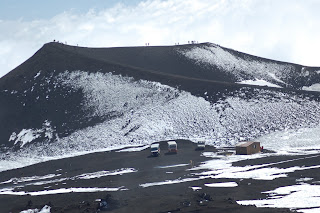
Here is the place for the obvious metaphor... like all trips, this one certainly had its highs and lows, but this was a good place to end!

Friday, March 28, 2008

Sicilian Baroque

Ragusa, Sicily - In 1693, Sicily experienced a massive earthquake that flattened many of the towns in the southeastern part of the island. They were all rebuilt by the same architect - a bloke named Rosario Gagliardi, whose Baroque inclinations are reflected in the swirls and twirls that adorn every facade; the monumental porticos flanked by columns; and - of course - the massive domes that crown the oversized cathedrals.

All that pomp and circumstance - I could take or leave it. But I adore the tiny details: the figures of philosophers and poets that perch atop the pillars, as if they are still proclaiming some wise words; the grotesque faces that peek out from from otherwise unadorned edifices; and the whimsical creatures that crouch under the eaves or bear the weight of the balconies on their backs.

We spent one day in Noto, which is considered to be one of the finest Baroque towns in Sicily. Nonetheless, there is not a lot going on in Noto, aside from the gi-normous cathedral and the shops stocked with Sicilian ceramics. I think the reason to stop in Noto is to study the many beasts and beauties that inhabit the Palazzo Nicoloci. This baroque building is adorned by at least half a dozen balconies, each supported by a team of carved creatures, whether gargoyle or gryphon, siren or sage. We spent an hour admiring the architecture and snapping photos; but then we were done. "Thanks for Noto!" Jerry said as we drove out of town.

Then we were on our way to Ragusa, another ancient city that was wiped out in 1693. After the earthquake, the town was rebuilt further up the mountain. But the old part of the city - Ragusa Iblea - was never abandoned. In 1730, Gagliardi came to town and built his signature spectacular cathedral, and redesigned the rest of the city around it. Today, Ragusa Iblea is a jumble of narrow streets and sand-colored structures that seem to be built on top of each other, climbing up the steep hillside. Driving into town, it looks like the city was carved out of the side of the mountain.

From here, we head further inland. first stop: Piazza Amerina and the Villa del Casale. Second stop: Enna and the Lombardy Castle.

Wednesday, March 26, 2008

It's all Greek to me...

Syracuse, Sicily - First, let me observe that the food is better in Sicily. Maybe this is a north-south thing - even Venetians have told me that the produce is fresher and more flavorful in the south. Also, the southerners invented - and have really perfected - the art of tomato sauces. And Sicilan chefs use nuts - pinenuts, walnuts and almonds - in ways you never imagined. So when I ordered spada alla sircusana, it turned out to be grilled swordfish with a tomato sauce with capers and almonds - delicious!

And the cheese... ravioli, panini and of course cannoli, all made with the freshest, smoothest ricotta. Note to self: eat as many canoli as possible while in Sicily.

Now that we have that out of the way, let's get on with exploring Syracuse. Set on the peninsula of Ortygia, which juts out into the Ionian Sea, Syracuse dates to 734 BC. Its Greek heritage is still evident in the ruins that are scattered about the city... a Temple to Apollo, the Castle of Euryalus,  Even the centerpiece Cathedral was built on the foundation of a Greek Temple that stood on the site. So the Doric columns that line the sanctuary are the same columns that upheld the Temple of Athena, dating back to the 5th century BC.

 Equally impressive is the Greek theater that is on the outskirts of town. It is still used for summer theater! I know some of my readers are fans of classical comedies... consider a trip to Syracuse to see them performed in them performed in their element!

 With the decline of the Greek Empire, the Romans moved in, and they also built an amphiteater. It's not clear why they could not use the perfectly good Greek theater up the road. Perhaps it was not suitable for the animal slaughters and gladiator fights that would be held in this arena.

From here, we head inland. Next stop: Noto.